Tuesday, September 7, 2010

Evolution in Action: Lizard Moving From Eggs to Live Birth


Evolution has been caught in the act, according to scientists who are decoding how a species of Australian lizard is abandoning egg-laying in favor of live birth.

Along the warm coastal lowlands of New South Wales (map), the yellow-bellied three-toed skink lays eggs to reproduce. But individuals of the same species living in the state's higher, colder mountains are almost all giving birth to live young.

Only two other modern reptiles—another skink species and a European lizard—use both types of reproduction. (Related: "Virgin Birth Expected at Christmas—By Komodo Dragon.")

Evolutionary records shows that nearly a hundred reptile lineages have independently made the transition from egg-laying to live birth in the past, and today about 20 percent of all living snakes and lizards give birth to live young only.

Read the Article

Monday, September 6, 2010

Neil deGrasse Tyson - Bad Design

2006 Neil DeGrasse Tyson speaks on bad design in the universe.


Hilarious.

Extract from Stephen Hawking's A Brief History of Time


"There are something like ten million million million million million million million million million million million million million million (1 with eighty zeroes after it) particles in the region of the universe that we can observe. Where did they all come from? The answer is that, in quantum theory, particles can be created out of energy in the form of particle/antiparticle parts. But that just raises the question of where the energy came from. The answer is that the total energy of the universe is exactly zero. The matter in the universe is made out of positive energy. However, the matter is all attracting itself by gravity. Two pieces of matter that are close to each other have less energy than the same two pieces a long way apart, because you have to expend energy to separate them against the gravitational force that is pulling them together. Thus in a sense, the gravitational field has negative energy. In the case of a universe that is approximately uniform in space, one can show that this negative gravitational energy exactly cancels the positive energy represented by the matter. So the total energy of the universe is zero." -Stephen Hawking

Magnificent.

Thursday, September 2, 2010

Jason Clay: How big brands can help save biodiversity

Convince just 100 key companies to go sustainable, and WWF's Jason Clay says global markets will shift to protect the planet our consumption has already outgrown. Hear how his extraordinary roundtables are getting big brand rivals to agree on green practices first -- before their products duke it out on store shelves.


About Jason Clay
Jason Clay is a WWF vice-president who works with big corporations to transform the global markets they operate in, so we can produce more with less land, less water and less pollution.

Charles Darwin's ecological experiment on Ascension isle

A lonely island in the middle of the South Atlantic conceals Charles Darwin's best-kept secret.

Two hundred years ago, Ascension Island was a barren volcanic edifice.

Today, its peaks are covered by lush tropical "cloud forest".

What happened in the interim is the amazing story of how the architect of evolution, Kew Gardens and the Royal Navy conspired to build a fully functioning, but totally artificial ecosystem.

By a bizarre twist, this great imperial experiment may hold the key to the future colonisation of Mars.

The tiny tropical island of Ascension is not easy to find. It is incredibly remote, located 1,600km (1,000 miles) from the coast of Africa and 2,250km (1,400 miles) from South America.

Its existence depends entirely on what geologists call the mid-Atlantic ridge. This is a chain of underwater volcanoes formed as the ocean is wrenched apart.

However, because Ascension occupies a "hot spot" on the ridge, its volcano is especially active. A million years ago, molten magma explosively burst above the waves.

A new island was born.

Back in 1836, the young Charles Darwin was coming to the end of his five-year mission to explore strange new worlds and boldly go where no naturalist had gone before.

Aboard HMS Beagle, he called in at Ascension. En route from another remote volcanic island, St Helena, Darwin wasn't expecting much.

"We know we live on a rock, but the poor people of Ascension live on a cinder," the residents of St Helena had joked before his departure.

But arriving on Ascension put an unexpected spring in Darwin's step.

Professor David Catling of the University of Washington, Seattle, is retracing Darwin's travels for a new book. He told the BBC: "Awaiting Darwin on Ascension was a letter from his Cambridge mentor, John Henslow.

"Darwin's voyage of discovery had already caused a huge sensation in London," he explained.

"Henslow assured him that on his return, he would take his place among the great men of science."

At this fantastic news, Darwin bounded forth in ecstasy, the sound of his geological hammer ringing from hill to hill.

Everywhere, bright red volcanic cones and rugged black lava signalled the violent forces that had wrought the island.

Yet, thinks Professor Catling, amid this wild desolation, Darwin began to hatch a plot.

Out of the ashes of the volcano, he would create a green oasis - a "Little England".

Read the Article

Wednesday, September 1, 2010

Are we living in a designer universe?


The argument over whether the universe has a creator, and who that might be, is among the oldest in human history. But amid the raging arguments between believers and sceptics, one possibility has been almost ignored – the idea that the universe around us was created by people very much like ourselves, using devices not too dissimilar to those available to scientists today.

As with much else in modern physics, the idea involves particle acceleration, the kind of thing that goes on in the Large Hadron Collider in Switzerland. Before the LHC began operating, a few alarmists worried that it might create a black hole which would destroy the world. That was never on the cards: although it is just possible that the device could generate an artificial black hole, it would be too small to swallow an atom, let alone the Earth.

However, to create a new universe would require a machine only slightly more powerful than the LHC – and there is every chance that our own universe may have been manufactured in this way.

Read the Article

White Fright

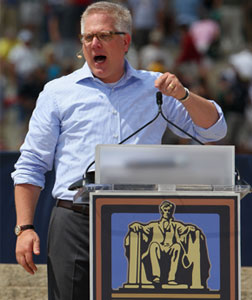
Glenn Beck's rally was large, vague, moist, and undirected—the Waterworld of white self-pity.

One crucial element of the American subconscious is about to become salient and explicit and highly volatile. It is the realization that white America is within thinkable distance of a moment when it will no longer be the majority. This awareness already exists in places like New York and Texas and California, and there have even been projections of the time(s) at which it will occur and when different nonwhite populations will collectively outnumber the former white majority. But it also exerts a strong subliminal effect in states like Alaska that have an overwhelming white preponderance.

Until recently, the tendency has been to think of this rather than to speak of it—or to speak of it very delicately, lest the hard-won ideal of diversity be imperiled. But nobody with any feeling for the zeitgeist can avoid noticing the symptoms of white unease and the additionally uneasy forms that its expression is beginning to take.

This summer, then, has been the perfect register of the new anxiety, beginning with the fracas over Arizona's immigration law, gaining in intensity with the proposal by some Republicans to amend the 14th Amendment so as to de-naturalize "anchor babies," cresting with the continuing row over the so-called "Ground Zero" mosque, and culminating, at least symbolically, with a quasi-educated Mormon broadcaster calling for a Christian religious revival from the steps of the Lincoln Memorial.

At the last "Tea Party" rally I attended, earlier this year at the Washington Monument, some in the crowd made at least an attempt to look fierce and minatory. I stood behind signs that read: "We left our guns at home—this time" and "We invoke the First Amendment today—the Second Amendment tomorrow." But Beck's event was tepid by comparison: a call to sink to the knees rather than rise from them. It was clever of him not to overbill it as a "Million"-type march (though Rep. Michele Bachmann was tempted to claim that magic figure). The numbers were impressive enough on their own, but the overall effect was large, vague, moist, and undirected: the Waterworld of white self-pity.

Read the Article